

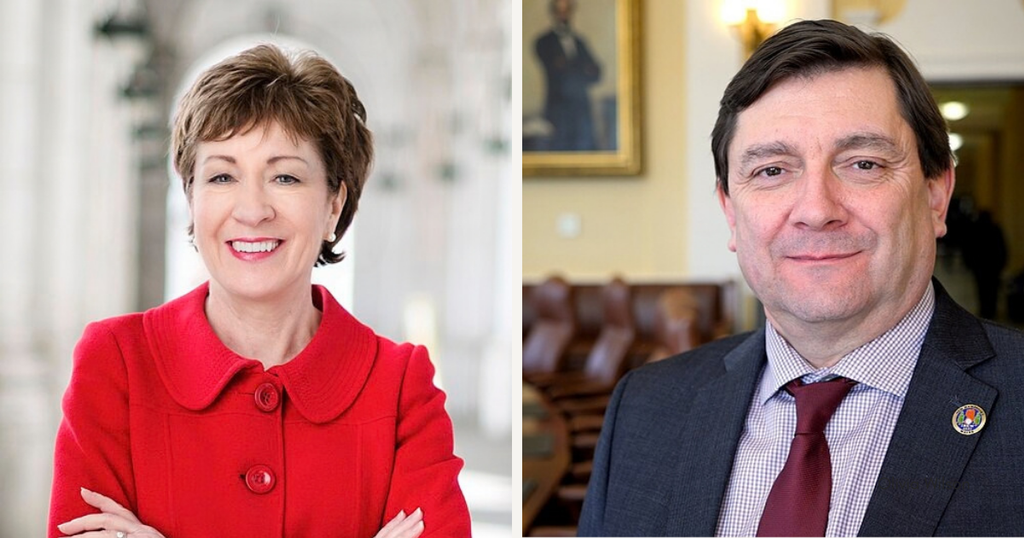
Maine’s U.S. Senate Race Remains a Toss-Up as Collins and Jackson Battle for Voters
Maine’s U.S. Senate race between Republican incumbent Susan Collins and Democratic challenger Troy Jackson remains one of the country’s most competitive contests, with polling offering conflicting signals about the outcome. A New York Times/Siena/Portland Press Herald poll released in late September put Collins ahead 49% to 46%, while other surveys, including those from UMass Lowell, UNH and AARP, showed Jackson with leads of varying sizes. The central question is whether Collins can continue attracting enough Democratic and independent voters to overcome a political environment that otherwise appears favorable to Democrats. Her success in winning crossover votes was a key factor in her 2020 reelection, and recent polling suggests she may again be positioned to outperform her party.
The race is also being shaped by an enormous advertising battle. Republican-aligned groups have outspent their Democratic counterparts on television advertising, using positive messaging for Collins and attacks on Jackson, while Democratic groups have pushed back with their own ads. Both candidates have faced scrutiny over personal and political controversies, including allegations reported by ProPublica involving Collins and a former donor, which Collins has denied. With debates continuing and Election Day approaching, the race is likely to hinge on voter turnout, ticket-splitting and whether the candidates’ competing messages on the economy, health care and national politics resonate with Maine voters.
READ MORE
Maine’s Governor’s Race Faces a Defining Test on Affordability and the State Budget
Democrat Hannah Pingree, Republican Bobby Charles and independent Rick Bennett are entering the final stretch of the gubernatorial campaign with different approaches to the state’s economic challenges. Affordability has become a central theme, with candidates and allied groups emphasizing heating costs, taxes, energy bills and household expenses. Charles has promoted using the state’s Rainy Day Fund to reduce heating oil costs and previously proposed $4 billion in state budget cuts, although he has begun backing away from that proposal. Pingree has highlighted her housing record, while Bennett continues to emphasize detailed policy proposals despite struggling to gain ground in polling.
The next governor will face a significant fiscal challenge: the state is projected to have a budget gap exceeding $1 billion in the next budget. That puts spending priorities, revenue and the sustainability of proposed tax and affordability measures at the center of the campaign. The outcome will also shape the relationship between the governor’s office and the Legislature, particularly if Democrats retain control and advance a more progressive agenda than the outgoing Mills administration. The candidates’ final debates offer an important opportunity to explain how their proposals would address household costs while managing the state’s financial outlook.
READ MORE
Legislative Control Is at Stake as Parties Pour Money into Maine’s Closest Races
Maine’s legislative elections are becoming increasingly competitive as party organizations and outside groups concentrate resources on a relatively small number of pivotal districts. Democrats have been investing heavily in Senate contests, seeking to protect vulnerable incumbents Mike Tipping, Tim Nangle and Craig Hickman while challenging Republicans Bruce Bickford and Scott Cyrway and pursuing an open seat in Augusta. The House presents a different map, with several closely divided districts offering Republicans opportunities to gain ground. One race between Democrat Sally Cluchey and Republican David Guilmette was decided by just 14 votes in 2024, while another neighboring contest has flipped between parties in consecutive elections.
READ MORE
Outside Political Spending Is Reshaping Maine’s Elections — and Raising Questions About Influence
Outside groups are playing an increasingly prominent role in Maine’s 2026 election campaigns, spending heavily on television, digital advertising, mail and other voter outreach. In the U.S. Senate race, spending has reached extraordinary levels, with national political organizations supplementing the candidates’ own campaigns. The legislative races are seeing a similar pattern: in eight of the nine leading battlegrounds across the House and Senate, outside groups have spent more than the two candidates combined have raised. The most expensive legislative contest identified in the reporting is the Auburn Senate race between Democrat Mike Scott and Republican incumbent Bruce Bickford, where outside spending has exceeded $210,000.
The funding is also revealing the competing interests and strategies behind the campaigns. Business-aligned groups have entered selected legislative races, backing Republican candidates in closely divided districts and citing economic policy concerns. National conservative and Republican organizations have contributed to efforts supporting legislative candidates, while Democratic-aligned groups, environmental organizations, labor interests and other national donors have provided substantial funding on the other side. In the gubernatorial contest, a PAC backing an effort to help independent Rick Bennett while opposing Pingree has reported significant contributions from wealthy donors. The scale of this spending underscores how national money and organized interests may influence Maine’s policy debates, even in races where local candidates have comparatively modest resources.
READ MORE
Early Voting Is Accelerating, but Party Registration Does Not Tell the Whole Story
Maine’s early voting activity is drawing attention as campaigns look for signs of voter enthusiasm ahead of November 3. By the latest reporting period, Maine had received approximately 130,000 absentee ballot requests, up 10% from the comparable point in 2022. Democrats continued to account for the largest share of requests, but their advantage was narrowing as the election approached. Unenrolled voters accounted for much of the overall growth, with requests from that group up 29% from the previous midterm. These voters could be particularly important in close statewide contests, including the U.S. Senate race.
In-person early voting has also emerged as a notable trend. Approximately 27,000 Mainers had already voted in person by the reporting period, roughly three times the pace at the same point in 2022 and slightly ahead of 2020. The reporting suggests that in-person voters are leaning much more Democratic than they did in recent elections, potentially changing the usual relationship between early voting and Election Day turnout. Still, absentee requests are not equivalent to votes cast, and historical patterns show that the partisan gap in requests often narrows before Election Day. Campaigns will need to watch both ballot returns and in-person turnout before drawing firm conclusions about the electorate.
READ MORE
Cost of Living Dominates Legislative Campaigns as Policy Debates Intensify
Affordability has become the defining message in Maine’s targeted legislative races, with both parties attempting to position themselves as the better choice for households struggling with everyday expenses. Democratic candidates and allied groups have highlighted utility costs, medical debt relief, property taxes, health care and child care. Republican-aligned campaigns have emphasized rising energy costs, taxes and the need for broader changes in Augusta. Business-backed candidates are also presenting economic growth and affordability as priorities, arguing that the next Legislature will play a central role in determining whether state policies help or hinder Maine’s economy.
The campaign messaging also shows how economic concerns are being combined with other divisive issues. Some Republican-aligned advertising pairs promises on taxes and utility bills with positions on transgender-related issues, while abortion-related messaging is appearing through Planned Parenthood’s political operation and its supported candidates. These competing messages reflect the broader policy choices facing Maine after the election: how to address household costs, fund public services and manage a projected budget gap while navigating disagreements over social policy. With outside groups playing a substantial role in many battlegrounds, voters are hearing increasingly targeted arguments about who is responsible for current costs and which party can offer meaningful relief.